


The Child Who Leads the Way - Waldorf & Montessori Philosophy Through Play
There’s a moment every parent knows. You’ve just given your child a beautifully wrapped gift — something bright, something that beeps and lights up and does everything for them. And within minutes, they’ve abandoned it entirely to play with the box.
It’s not ingratitude. It’s instinct.
Children, especially in their earliest years, are drawn to the open, the simple, the real. They don’t want a toy that performs. They want something they can become with.
This is the quiet wisdom behind two of the most thoughtful approaches to early childhood ever developed: Waldorf and Montessori. And it’s the same wisdom that lives inside every handcrafted wooden toy we make at Noelino.
Two Philosophies, One Heart
Maria Montessori and Rudolf Steiner never met. They came from different countries, different traditions, different centuries. And yet, looking at what each of them believed about children, you find the same deep thread running through both.
Children are not empty vessels waiting to be filled. They are whole human beings — curious, capable, and longing to make sense of the world through their own hands.
Montessori, a physician working in Rome at the turn of the 20th century, watched children in under-resourced classrooms teach themselves. She saw that when given the right materials and the freedom to choose, children would focus with a depth of concentration that surprised even their teachers.
Steiner, an Austrian philosopher and educator, believed that childhood wasn’t a rehearsal for adult life — it was life, deserving its own rhythms, its own beauty, its own pace. He spoke of protecting the child’s imagination as you would protect a flame in the wind.
Both of them, in their own way, were saying the same thing: slow down. Let the child lead.
What This Looks Like in Practice
In a Montessori environment, a child might spend forty minutes arranging wooden beads by size — not because a teacher told them to, but because something in the activity called to them. This is what Montessori called the work of childhood: purposeful, self-directed, deeply satisfying.
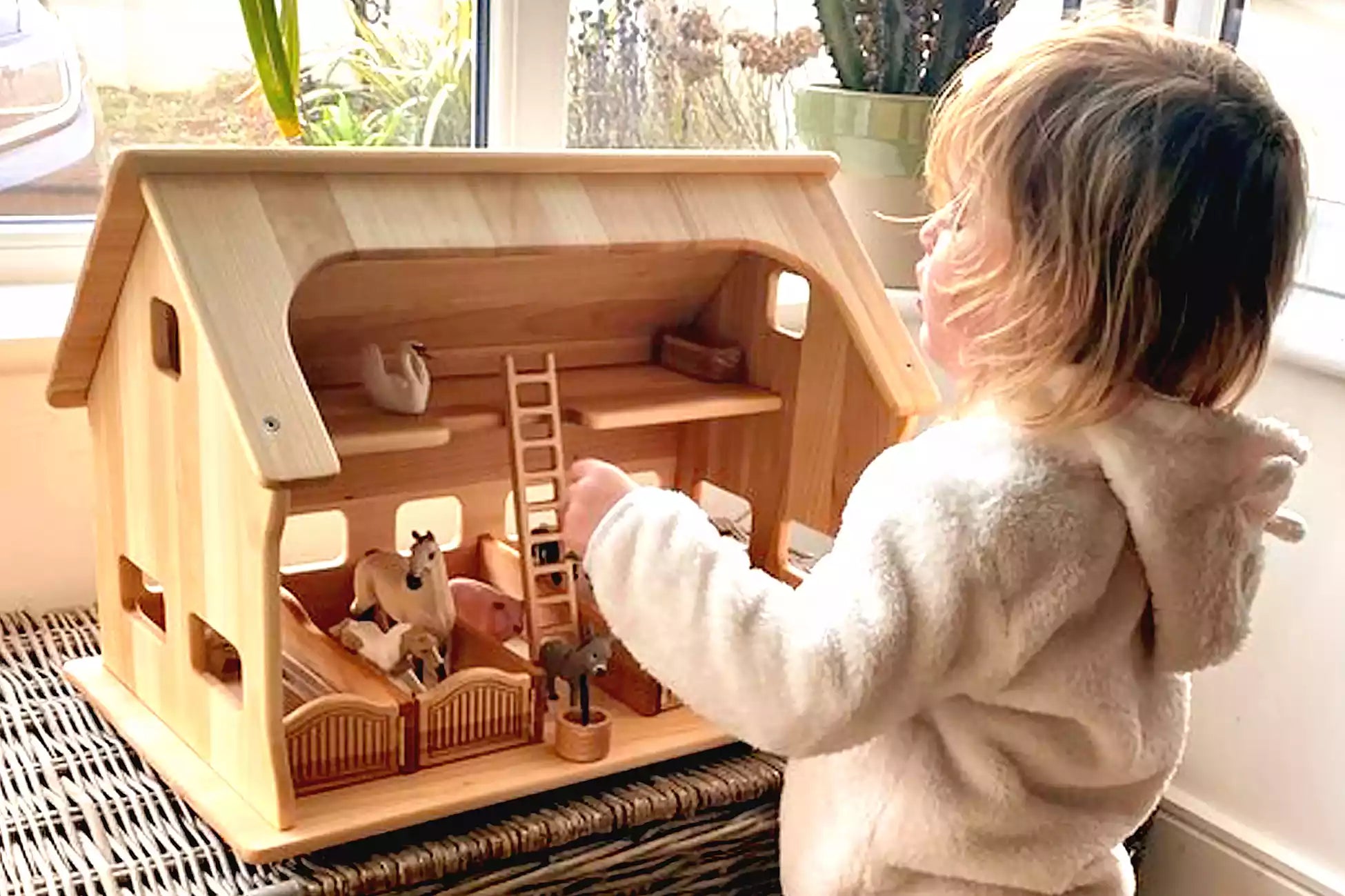
In a Waldorf kindergarten, there are no screens, no plastic toys with flashing lights. Instead, there are silks and wooden figures, simple dolls with soft features, and materials that ask the child’s imagination to do the heavy lifting. A round wooden figure can be a guardian, a traveller, a friend — depending entirely on what the child needs it to be.

Wooden Snow Owl Family – handcrafted at Noelino
Both approaches honour what research now confirms: open-ended play is one of the most powerful things a child can do for their developing brain. When a child plays with a toy that has no script — no correct answer, no predetermined outcome — they are exercising the same mental muscles that will one day help them solve problems, regulate emotions, think creatively, and connect with others.

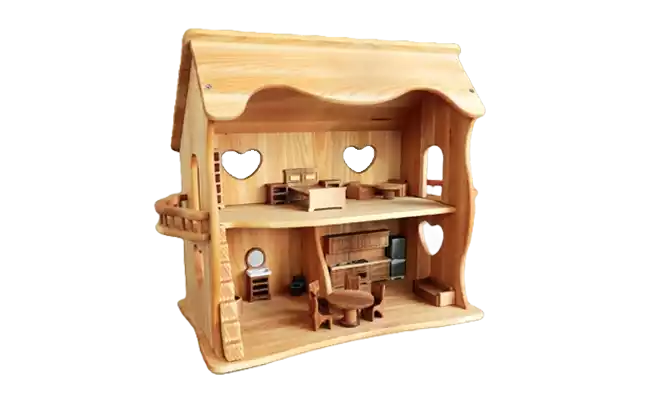
The Mothertree Dollhouse – a world the child builds themselves
The Role of Materials
Here is where the philosophy becomes tangible. Because what a toy is made of matters more than most people realise.
Plastic, for all its versatility, communicates something cold to the senses. It is light, uniform, indifferent. It doesn’t smell of anything. It doesn’t warm to the touch.
Wood is different. Wood has weight. It has grain. It has warmth. When a child holds a wooden figure — really holds it, turns it in their hands, runs their thumb along the curve of it — they are receiving information through their skin, their muscles, their whole body. Sensory experience and learning are not separate things in early childhood. They are the same thing.
This is why, at Noelino, we work with ash, cherry, and linden wood. Not for aesthetic reasons alone — though yes, they are beautiful — but because these are woods with character. They carry the weight and warmth that a child’s hands deserve. Every piece is hand-painted with water-based, solvent-free paints and finished with olive oil. No plastics, no solvent-based finishes, no MDF, no veneers — solid wood and a finish chosen to be safe in a child’s mouth.

Wooden Squirrel Family – ash wood, olive oil finish
Letting Go of the Idea That More is More
One of the most liberating things both Waldorf and Montessori teach parents is this: less is more.
A child with forty toys is, paradoxically, often a child who doesn’t know how to play. Too much choice creates noise. It fragments attention and flattens imagination.
A child with a few carefully chosen, open-ended objects — a small family of wooden animals, a simple house, a set of figures — will return to those objects again and again, finding new stories in them each time. This is the essence of small world play — and it’s one of the most valuable things a child can do.

Rabbit Family Set – a few pieces, endless stories
The toy doesn’t change. The child does.
And that, in the end, is what all of this is really about. Not the toy. The child. The way they grow when given space, simplicity, and the quiet confidence that they are capable of leading their own play.
At Noelino, we make toys for that child.

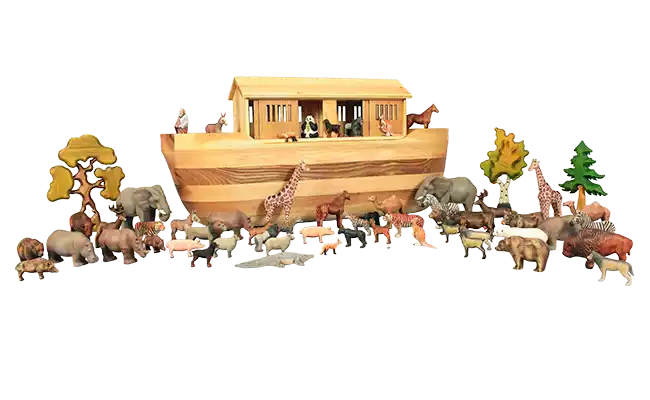
Wooden Noah’s Ark with Animals – where the Noelino story began