

Article: What Is Small World Play? A Parent's Guide to Imaginative Wooden Play

What Is Small World Play? A Parent's Guide to Imaginative Wooden Play
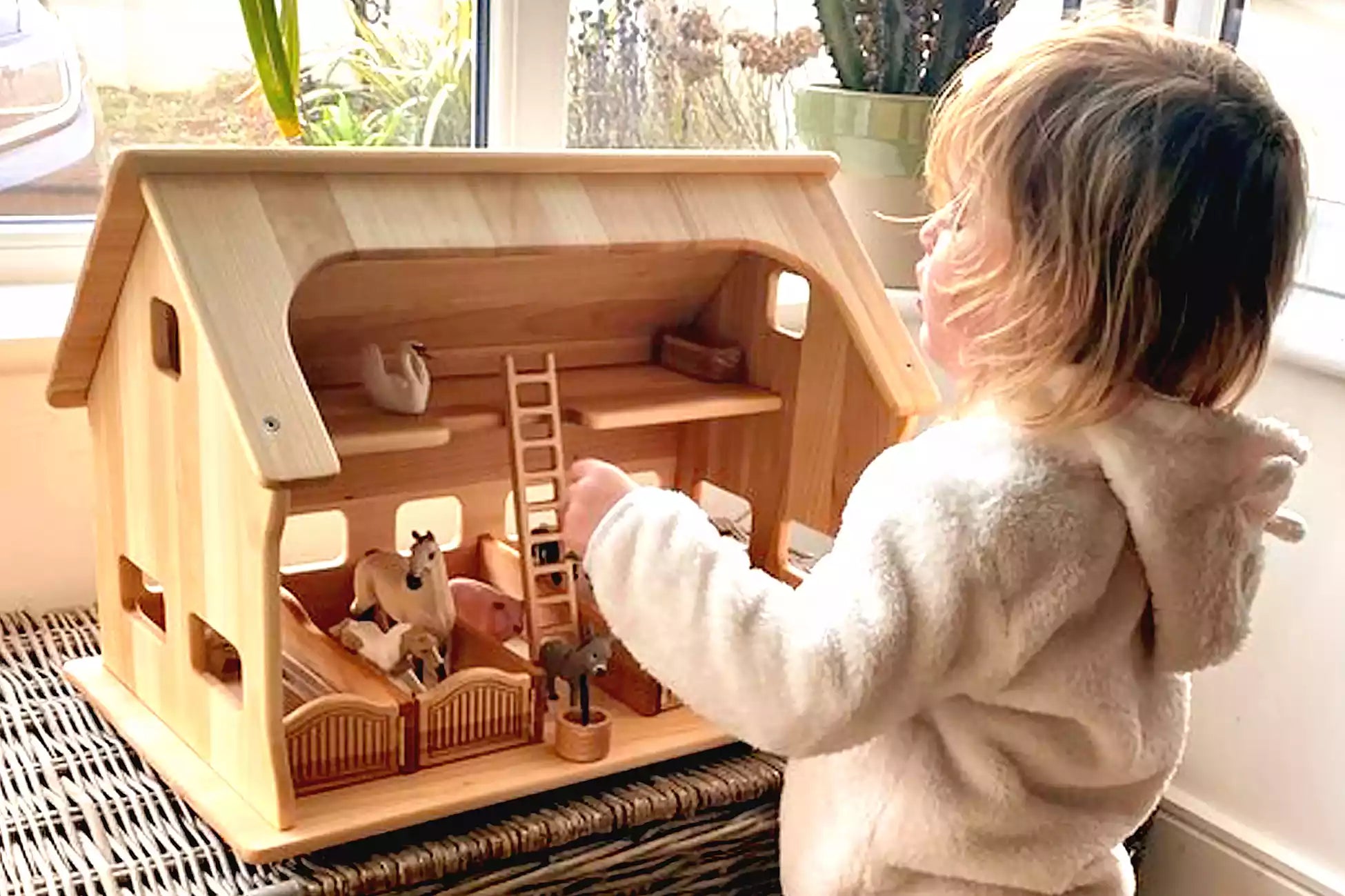
On the living-room floor, a child has built a world. A small wooden house sits at the centre of it. Around it, a family of carved animals goes about their day — one is sleeping, one has wandered off and must be found, one has been appointed, by royal decree, keeper of the door. A leaf has become a blanket. A pebble has become a loaf of bread. None of this was suggested by an adult. None of it came with instructions.
This is small world play. And it is one of the most important things a young child ever does.
If you’ve ever watched a child disappear into a tiny landscape of figures, houses, and improvised props, you’ve seen it. Small world play is the quiet, absorbed business of building a miniature world and living inside it for a while. It looks like simple play — and it is — but underneath, a great deal of serious developmental work is taking place.
It’s also the kind of play nearly every set we make is built for. So it felt worth explaining properly: what small world play is, why it matters so much, the age it begins, and how to set it up at home.

Wooden Squirrel Family & Acorn House — a small world ready to be lived in
What is small world play?
Small world play is when a child creates and controls a miniature version of a real or imagined world — a forest, a farm, a fairy village, a family home — using small figures, animals, and everyday objects. The child isn’t a spectator. They are the narrator, the director, and every character at once.
The difference between this and playing with a toy that lights up and sings is the direction of the energy. A toy that performs does the imagining for the child; the child simply watches. In small world play, the energy flows the other way. The house just sits there. The little figure says nothing. It is the child who decides that today the house is a hospital, that the smallest animal is frightened, that everything will be all right by bedtime. The toy stays still so the imagination can move.
What small world play does for a developing child
It looks like nothing. It is, in fact, almost everything.
Language. A child at small world play narrates constantly — giving characters voices, sequencing events, explaining what happens next. This is vocabulary and storytelling being built in real time. Empathy. When one figure is sad and another comes to help, a child is rehearsing how it feels to be someone else. Emotional processing. Big or confusing experiences — a new sibling, a trip to the doctor, a goodbye — become manageable when played out in miniature, on the child’s own terms. Sequencing and problem-solving. Stories have an order; problems inside them need solving. Fine motor skill. Small hands arranging small figures are quietly strengthening, too.
None of this is taught. All of it is practised — willingly, repeatedly, for the sheer pleasure of it.
What age is small world play for?
It arrives gradually, and then it stays for years.
Around eighteen months to two years, the first hints appear: a child walks a wooden animal across the floor and into a house, over and over. The story is wordless and simple, but it is a story. By three and four, small world play blossoms fully — characters acquire names, habits, and problems, and a single storyline might run for days. At five, six, and beyond, the worlds grow elaborate, populated, and surprisingly consistent, returned to like a favourite book.
If you’re shopping for a younger child specifically, we go age by age in our guide to the best Waldorf toys for toddlers (ages 1, 2 & 3).

Rabbit Family & Carrot House — a meadow and a burrow to come home to
The magic of loose parts and open sets
The best small world materials are the ones that suggest a world without defining it — what educators call loose parts. A few figures, a simple house, and then whatever the child gathers: a handful of stones, a few dried leaves, a square of cloth. The fewer rules an object carries, the more a child can pour into it.
A plain wooden house can be a home one morning and a shop, a castle, or a hospital by afternoon. A figure with a gentle, open face can be a mother, a traveller, or a friend — whatever the story needs. This is the same quiet principle that sits at the heart of both Steiner and Montessori; if you’d like the deeper thinking behind it, we wrote about Waldorf & Montessori philosophy through play in an earlier article.
Small world play ideas to try at home
You don’t need much. One house and one family of figures is enough to begin. Here are a few scenes that children return to again and again.
A woodland under the table. An Acorn Fairy House and a Squirrel Family become a whole forest the moment you add a few real twigs and leaves gathered from a walk. A meadow and a burrow. The Rabbit Family with their Carrot House invites stories about home, family, and coming back safe. A little farm. A handful of wooden farm animals on a folded brown blanket becomes pasture, pen, and barnyard. A fairy village. A Mushroom House and a set of carved gnomes are all it takes for an entire small folk to move in.

Wooden Mushroom House — the heart of a fairy village
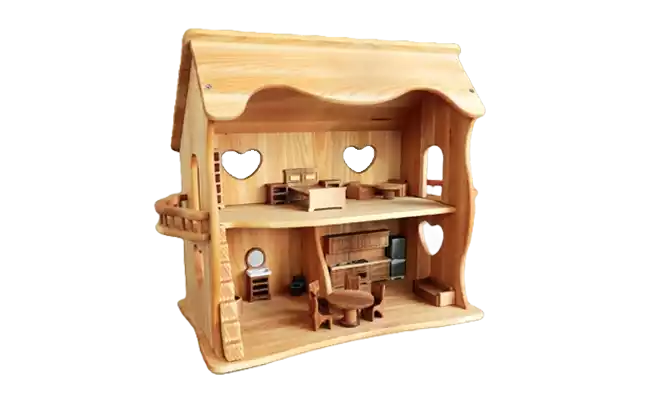
For a story that needs a true home base — somewhere characters live, sleep, and return to — a dollhouse like the Mothertree Tree Dollhouse anchors everything. The one rule worth keeping: leave room for the child’s own additions. The most magical prop in any scene is almost always the stone they found themselves.

The Mothertree Dollhouse — a home for any small world
Choosing your first small world set
It’s tempting to reach for the biggest plastic playset you can find — the one with forty pieces and a printed backdrop. But a child rarely needs forty pieces. They need a few good ones, open enough to become anything, made well enough to survive years of being loved.
Start with one house and one family of figures. Choose simple shapes over busy detail — a figure that looks exactly like one character from one film can only ever be that character, while an open wooden figure can be anyone. And choose materials a child will want to hold: wood that has weight, warmth, and grain, not the cool sameness of plastic. These are the sets that don’t get discarded after ten minutes. They’re the ones still being played with when a younger sibling comes along.
Wooden vs plastic small world sets
A quick comparison of what each kind of set actually offers a child.
| What matters | Handmade wooden set | Mass-produced plastic set |
|---|---|---|
| Open-ended play | Simple forms become anything the story needs | Often fixed characters tied to one franchise |
| Sensory experience | Real weight, grain, and warmth in the hand | Light, uniform, the same to the touch |
| Materials & safety | Solid hardwood, water-based paint, olive oil finish | Mixed plastics and synthetic coatings |
| Durability | Made to last decades, passed between siblings | Often cracks or is outgrown within a season |
| Cost over time | Higher upfront, lower per year of use | Cheaper upfront, frequently replaced |
A note on materials and safety
Every Noelino piece is made from responsibly sourced hardwood — ash, cherry, and linden — shaped with precision using modern woodworking tools and finished entirely by hand. Each piece is sanded through multiple grits, then hand-painted with water-based, non-toxic paints and finished with olive oil. No plastics, no solvent-based finishes, no MDF, no veneers — just solid wood and a finish that is safe for a child who will inevitably put it in their mouth.
The world the child builds
A child given a small wooden house and a handful of figures has been handed something rare: a world with no rules but their own. They will fill it with language, with feeling, with problems solved and goodbyes rehearsed and families kept safe through the night. And tomorrow they will do it all again, differently.
The toy doesn’t change. The child does.
At Noelino, we make toys for that child.

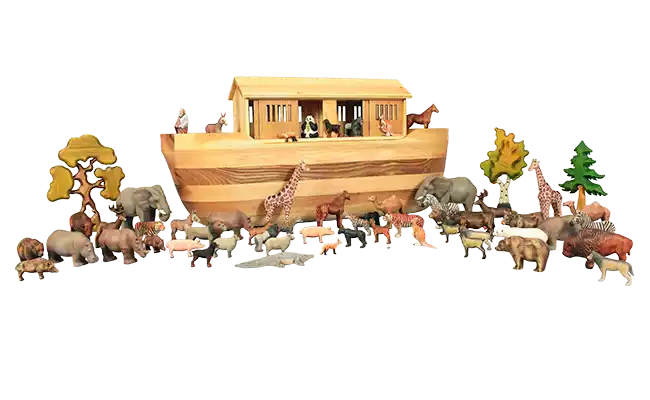
Wooden Noah’s Ark with Animals — where the Noelino story began
Small world play: common questions
What age is small world play for?
It begins around 18 months to 2 years with simple scenes, blossoms between ages 3 and 4 as children build named characters and storylines, and continues through ages 5, 6, and beyond with elaborate, ongoing worlds.
What are the benefits of small world play?
It builds language and storytelling, empathy and perspective-taking, emotional processing, sequencing and problem-solving, and fine motor skills — all through self-directed play.
What toys do you need for small world play?
You need very little: one simple house or play environment, one family of open-ended figures or animals, and a few natural loose parts the child can gather, such as stones, leaves, or a square of cloth.
What is the loose parts approach?
Loose parts are open-ended objects with no fixed use — a few figures, a plain house, and natural materials — that a child can combine and recombine freely. The fewer rules an object carries, the more imagination a child can pour into it.
What are some easy small world play ideas?
Try a woodland with a fairy house and animal family, a meadow and burrow scene, a small farm on a folded blanket, or a fairy village with a mushroom house and gnomes — then let the child add their own found objects.